
Anti-slip mats are essential tools in modern cargo securing. By increasing friction between the load and the vehicle floor, they minimize sliding and tipping risks during braking, acceleration, or cornering. However, their effectiveness depends on correct usage. This guide explains why proper use matters, the best practices for placement and maintenance, and common mistakes to avoid, helping you meet EN 12195 and VDI 2700 standards.
Why Proper Use Matters
Anti-slip mats work by increasing the coefficient of friction (µ) between the cargo and the loading surface. Without mats, friction is often low (µ ≈ 0.2–0.3), allowing loads to slide even with moderate braking forces. With mats, µ can reach 0.6 or higher, significantly reducing residual securing forces.
However, mats do not replace lashing or blocking; they complement these methods. Misplaced or contaminated mats can fail and create a false sense of security. European regulations (EN 12195, VDI 2700, and EU Directive 2014/47/EU) require proper securing and shared responsibility among drivers, loaders, and carriers.
Positioning and Placement
Correct placement is critical to achieving maximum friction and stability:
- Place mats directly under every load contact point: pallet runners, coil chocks, machinery bases, big bag corners.
- Ensure full-surface contact between mat and load to prevent gaps that reduce friction.
- Use enough mats to cover all weight-bearing points. For pallets, three strips (under each runner) is standard practice.
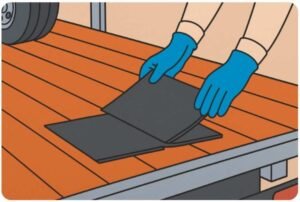
- Do not overlap mats—this creates uneven surfaces and instability.
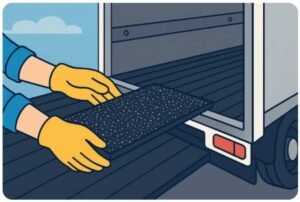
Why it matters: Proper coverage ensures load stability and prevents localized stress that can damage mats or cargo.
Keeping Surfaces Clean
Contamination like oil, grease, dust, or moisture reduces friction dramatically.
- Inspect and clean mats and vehicle floors before loading.
- Remove oil stains, ice, or debris to maintain friction levels.
- Store mats in clean, dry areas when not in use.

Combining Mats with Lashing
Even with high-friction mats, lashing remains essential to prevent tipping or shifting during emergency maneuvers.
- Calculate securing forces according to EN 12195 formulas.
- Use mats to reduce the number of straps needed but never skip them entirely.
- Combine mats with blocking/bracing and proper lashing angles.

Example: A 1,000 kg pallet may need eight straps without mats, but only four when µ increases from 0.2 to 0.6.
Inspection and Maintenance
Mats are reusable but require care:
- Inspect before each use: replace mats with cuts, cracks, or permanent compression marks.
- Clean regularly with mild detergent; avoid chemicals that damage rubber.
- Store mats flat and dry to prevent warping and contamination.

Common Mistakes to Avoid
- Using mats that are too small for the load base.
- Placing mats on sharp edges without protective boards.
- Overlapping mats, creating uneven support.
- Ignoring contamination or assuming all mats have the same friction rating.
Training and Legal Responsibilities
Correct use requires training on:
- Proper mat placement and securing calculations.
- Inspection for contamination or damage.
- Legal obligations: driver, loader, and carrier share liability for load securing under Directive 2014/47/EU.
Training reduces accident risk, prevents fines, and ensures compliance with VDI 2700 and national guidelines.

Key Takeaways
- Anti-slip mats enhance friction but never replace lashing.
- Correct positioning and clean surfaces are essential.
- Regular inspection and maintenance extend mat life and ensure performance.
- Compliance with EN 12195 and VDI 2700 protects safety and reduces liability.
References
- European Commission – Road Safety Portal
- Directive 2014/47/EU – Roadworthiness Checks (EUR-Lex)
- UNECE – Transport of Cargo Guidelines
- VDI – Load Securing Guidelines (VDI 2700)
- ISO – International Standards for Load Securing
- EU-OSHA – European Agency for Safety and Health at Work
Disclaimer
The information on this page is for general guidance only and should always be checked and adapted to each specific situation and applicable rules.
Although compiled with care, no guarantee is given for completeness or suitability.


